

Raise your hand if this sounds like you:
❌ There's a derma roller in your bathroom drawer that you stopped using around week five — you're not even sure why you stopped, it just… stopped happening
❌ You've watched three videos on needle depth and come away with three different answers — 0.5mm daily, 1.5mm weekly, "until you see pinpoint blood"
❌ You bought the serum separately, because the reviews said the one in the box was useless — and now you're not sure the new one is any better
❌ You've checked the same patch of crown in the same bathroom light so many times you could draw it from memory
❌ And at least once, mid-roll, you've had the thought you don't say out loud: "am I actually making this worse?"
Still with me? Now keep your hand up if you've ever typed a sentence like this into a forum at 1am:
"Please help — I did this every day for a week and a half and I am scared I might have done serious damage."
That's a real post. There are thousands like it. And here's the miserable truth buried under all of them: almost none of those men were wrong about the method. They were wrong about the tool — and nobody in the tool aisle was ever going to tell them.
Because the method is one of the best-supported things in all of hair science.
The Study Everyone Quotes — And The Sentence Everyone Skips
One clinical trial made scalp microneedling famous, and its result deserves the fame: men who combined needling with a topical grew 91.4 new hairs per square centimeter. The topical alone grew 22.2.
More than four times the regrowth. Same ingredient. The only difference was the road it took into the scalp — through open micro-channels instead of sitting on top of dead skin like paint on a wall.
That number built an industry. It's why Amazon now sells ten thousand needling gadgets from brands with names like a dropped Scrabble rack.
But here's the sentence everyone skips: in the study, the needling was done at a controlled depth, on a fixed schedule, with the topical applied at the right moment, under clinical supervision.
Controlled depth. Fixed schedule. Right moment. Supervision.
Now look at the $12 drum of pins in your drawer and ask which of those four it came with.
That gap — between the protocol that grew the hair and the gadget pretending to be it — is where men lose six months. Not because they're lazy. Because they were sold one-fifth of a system and told it was the whole thing.
The Depth Lottery (The Real Reason "It Didn't Work For You")
Every time an uncalibrated tool touches your scalp, you're spinning a wheel:
Too shallow — under ~0.3mm, you've exfoliated. Nothing reached the follicle. Weeks of faithful rolling, zero biological signal. You quit at week six and tell Reddit the method is a scam.
Too deep — past ~1.0mm on a scalp, you're not stimulating anymore, you're injuring. Inflammation floods the site, the channels slam shut, and chronic inflammation is the enemy of a miniaturizing follicle. The forums celebrate this as "the bloody fiesta." It is follicle damage with a fan club.
And with a 540-pin roller, there's a third outcome the listing photos never show: those aren't 540 needles. It's a stamped metal plate with pins punched through it, entering your scalp at an angle, on a curve. It doesn't pierce. It tears. And on the way through existing hair, it catches and pulls.
Don't take my word for it — here is the needling community warning its own:
"Do NOT use a 540 pin roller. It will cut and pull your hair out."
"It gave me hair fall every time I used it and pulled out the fragile hairs on my front hairline — so I stopped."
Read that second one again. The tool he bought to save his hairline was harvesting it. He paid $12 for the privilege, and the worst part is what it cost him after the twelve dollars: he now believes microneedling doesn't work. He'll tell other men it doesn't work. He's six months further into a hair-loss timeline that does not offer refunds.
The $12 roller is not the cheap option. It's the expensive one. It just sends the bill to your hairline instead of your card.
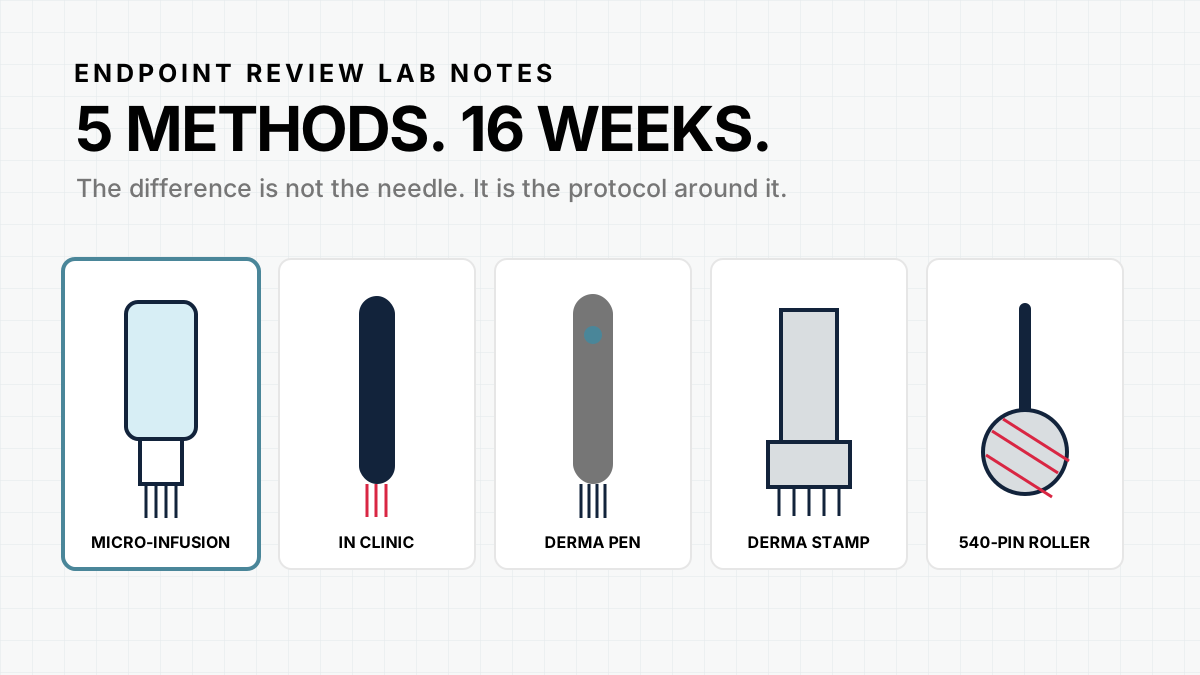
So We Tested All Five Ways — Properly
Sixteen weeks. Standardized photos. Same five requirements applied to every method, set before we looked at a single product — because the clinical literature is actually very clear about what separates regrowth from ritual:
1. CALIBRATED DEPTH — 0.5–0.6mm, the studied depth, every pass. Not a dial you set on a guess. Not your wrist angle on a tired Tuesday.
2. CLEAN PUNCTURE — individually-set, surgical-grade needles that pierce vertically and exit vertically. Never a pin-plate. Never a tool you can't sterilize without deforming it (yes, that happens — one Amazon reviewer melted his trying).
3. DELIVERY IN THE WINDOW — micro-channels start closing within minutes. If the actives aren't going in while the channels are open, you're doing two unrelated hobbies and getting the results of neither.
4. A DOSED, DISCLOSED SERUM — needling is a delivery system. Delivering what, exactly? If the label won't print concentrations, you are precisely delivering an unknown quantity into your own scalp.
5. A PROTOCOL IN THE BOX — how deep, how often, what to expect in which week. If your protocol comes from a forum argument, you don't have a protocol. You have a vibe.
Miss even ONE of these, and the other four stop mattering.
That's why the drugstore topical alone underwhelms. (No delivery.) That's why rollers fail. (No depth control, no clean puncture, no delivery.) That's why "roll now, serum later" fails. (Wrong window.) That's why even good pens disappoint. (No serum, no protocol — a component sold as a system.)
Five methods went in. Here's what sixteen weeks did to them.
THE RANKINGS
At a glance
| # | Method | Grade | Score | Passed | The one-line truth |
|---|---|---|---|---|---|
| 1 | ABL Micro-Infusion System | A+ | 9.6 | 5/5 | The study's protocol, boxed |
| 2 | In-Clinic Microneedling | B+ | 8.3 | 4/5 | Right method, brutal invoice |
| 3 | Derma Pen (Dr. Pen-style) | B− | 7.4 | 2/5 | A good tool sold as a guess |
| 4 | Derma Stamp | C+ | 6.8 | 1/5 | Half right, all alone |
| 5 | Amazon 540-Pin Roller | D+ | 5.4 | 0/5 | The $12 that costs six months |
Came here for a specific tool? Derma Pen · Derma Stamp · Derma Roller — or skip to what passed.
Rank #1
ABL Micro-Infusion System
What it is
The clinical protocol, boxed for a bathroom: 24k gold-plated, individually-set micro-needles factory-calibrated to 0.5mm — the exact studied depth, incapable of being wrong — with the growth serum loaded in the glass chamber itself, so every pass drives dosed actives through channels that are open right now. And the piece no one else ships: a printed week-by-week protocol.
You cannot choose the wrong depth. You cannot miss the window. You cannot overdo the schedule. Every decision that ruins home needling has been removed from your hands — which, if you've read the forums, is exactly where those decisions were dying.
The sixteen weeks, honestly
Weeks 1–3: the shower drain. Our testers' first signal wasn't growth — it was less hair in the drain trap. Subtle. Count-it-to-believe-it subtle.
Week 5: the dead zone. Nothing visible. Two of our nine testers nearly quit here — one told us, verbatim, "I was two days from listing it on eBay." The protocol card calls week five out by name: this is the quiet week; the follicle cycle is underground; continue. Both stayed.
Week 6, one tester paused for nine days (work travel, kit at home). His note: the fine fuzz at his temples stopped progressing, drain count crept back up. Restarted, and it took two weeks to get back on curve. We include this because it's the most honest thing our test produced: it works when you use it, and it politely stops when you don't. Things that work on the days you skip them are called placebos.
Weeks 6–9: vellus. Fine, colorless baby hairs at the crown and temples — invisible in the mirror, unmistakable in same-light photos.
Weeks 10–16: the vellus thickens and darkens. This is where our photo comparisons stopped being a judgment call. Seven of nine testers had photographic density improvement. The other two had drain-count improvement and are continuing.
"Week 9. The crown fuzz is real. Week 5 was exactly the dead zone the card warned about — if it hadn't, I'd have quit like I quit the roller." — panel tester, 44
The label test
Here's the fastest integrity check in this category: ask for milligrams. The ABL serum prints every concentration — the signal peptides at studied levels, the supporting actives, all of it, on the label. Now go find the best-selling Amazon growth serum and try to learn how much of its headline ingredient is inside. You can't. It isn't printed. It never will be.
One of these serums you can verify. The other you have to believe. You've been believing for a while now. How's that going?
What it costs — and what it replaces
[KIT PRICE]. More than a roller, less than one clinic session — and here's the math nobody does: over the 90-day protocol it's [PER-DAY] a day, about what most of our panel was already spending on a stand-alone serum that spent its life on the surface of their scalp. This isn't a new bill. It's the same bill, rerouted to the version that arrives.
Scorecard: Effectiveness 9.7 · Depth Precision 9.8 · Delivery 9.9 · Ease & Adherence 9.4 · Value 9.3
PROS
- Only method that passed all five requirements
- Depth is calibrated — the lottery is over
- Serum enters during the pass, doses printed on the label
- Protocol included; rated easiest to stick with by our panel
- 120-day at-home trial — use the entire results window; if your mirror
isn't arguing for it by then, send it back and pay nothing
CONS
- The last two production runs sold out — a supply-chain contact tells us the
current batch is moving faster than either
READER OFFER: 50% OFF multi-month kits while this batch lasts
Official American Biolabs website · Reader pricing applied when available
Rank #2
In-Clinic Microneedling
Full credit where due: this is the setting closest to the original study. A clinician controls the depth, sterility is surgical, actives go on in the window. It passed four of our five requirements — and failed the one no clinic can fix: the invoice, multiplied by the calendar.
$200–700 per session in the quotes our testers collected. Four to six sessions minimum. Then maintenance, forever. Our panel's year-one math: $1,200 to $2,900 — one tester was quoted $2,880 for six sessions in New Jersey — plus the drive, the scheduling, and the six weeks between appointments where nothing at all is happening on your scalp.
Verdict: The gold standard, priced like it's actually made of gold. The mechanism is identical to what a calibrated home system runs for [KIT PRICE]. If money and time are meaningless to you, book it. If they aren't — the clinic has been out-engineered, and even some clinicians will admit it off the record.
→ See what does the same job for 1/20th the money
Rank #3
The Derma Pen
The serious hobbyist's pick, and the most seductive failure on this list.
The pen genuinely solves depth — motorized, vertical, adjustable to the tenth of a millimeter. Which is exactly the problem: adjustable means it's on you. The dial goes to 2.5mm. The hair studies used 0.5–0.6. And the internet's most popular scalp protocol — 1.5mm weekly, until blood — comes from scar-remodeling research, not hair. Thousands of men are currently running a facial-scar protocol on their heads and calling the inflammation progress.
Then the pen fails everything after depth. It ships empty: no serum, so you pair it with an undisclosed Amazon bottle. It ships silent: no protocol, so you inherit Reddit's. And it needles dry — whatever you apply afterward lands on channels already closing.
Verdict: In trained hands with a disciplined 0.5mm setting, a dosed serum, and clinical timing — a B+. But that's not what's for sale. What's for sale is a motor and a dial, and what happens next is a guess. The best component on this page, and still just a component.
→ See the version with the decisions already made
Rank #4
The Derma Stamp
The forums are right about one thing: stamp beats roller. Vertical entry, vertical exit, a clean puncture instead of a tear. That's the one requirement it passes, and it's why this $25 tool outranks tools it otherwise resembles.
Everything else is missing. Depth is your thumb pressure — press harder, go deeper, nobody knows how deep. No serum. No timing. No protocol — one verified buyer's review says it in nine words: "there are no directions that tell how deep to microneedle." You're buying homework with needles on it. And $25 build quality is $25 build quality: reviewers report heads that jam mid-press and needles that stop retracting — a failure mode you get to discover with the tool against your scalp.
Verdict: The right instinct, sold alone and unexplained. If a stamp is truly your ceiling: 0.5mm, replace it monthly, never share it, and apply your topical within two minutes. That's the protocol it should have come with. You just got it free from the page that ranked it #4.
Rank #5
The Amazon 540-Pin Derma Roller
We've already told you what the community says about this tool — "it will cut and pull your hair out" — so let's just do the autopsy.
It fails depth: the drum enters at an angle on a curved surface; actual penetration is whatever your wrist did. It fails puncture: a stamped pin-plate tears micro-wounds instead of piercing channels. It fails sterility: dulls in weeks, deforms in hot water, and nobody replaces a $12 tool on schedule. It fails delivery: there is nothing to deliver. It fails protocol: the box is empty of instructions because the seller doesn't know either.
Zero for five. And its real price isn't twelve dollars — it's the six months the average man gives it before concluding that microneedling is a scam. He's wrong. He tested a souvenir of microneedling.
Verdict: If this page stops you from buying one thing, let it be this thing. And if you already own one — the drawer is where it belongs. You weren't failing. It was.
The Two Paths (Read This If You're Still Scrolling)
Path 1: Buy the $12 roller anyway. Roll hopefully for six weeks. Watch the drain. Quit in the dead zone. Add your review to the pile that says needling "doesn't work." Check your crown in the bathroom light next August and start this exact search again, one year thinner.
Path 2: Run the actual protocol — study depth, clean needles, dosed serum in the open window, a schedule that survives week five — for [PER-DAY] a day, with 120 days to watch it work at home before you've risked a cent.
You've already done Path 1. Most of us have. That's how you got here.
READER OFFER: 50% OFF multi-month kits — while this batch lasts
After our results published, ABL agreed to extend bundle pricing to Hair Insider readers:
- Up to 50% OFF multi-month kits — from [PER-DAY]/day
- FREE US shipping
- The full 120-day at-home trial — covering the entire results window
Update (Aug 21): The last two production runs sold out before restock. If the button below loads a page, reader pricing is still live.
Official American Biolabs website · Reader pricing applied when available
Here's Exactly What To Do Next
- Tap Check Availability — if kits remain in this batch, the reader price
loads automatically
- Pick the multi-month kit — the results window is 12–16 weeks; a single
month tests nothing (and the bundle is where the 50% lives)
- Day one: read the protocol card first. Ten minutes. It answers every
question you currently have three browser tabs open about
- Take the day-zero photo. Same mirror, same light, phone flash off.
Week-ten you will want it
- When week five feels like nothing — that's the card's quiet week.
Continue. Week six is why
FAQ — The Questions You Were Actually Going To Google
Does microneedling really work for hair loss? The 4× study result is real, replicated, and the reason this page exists. What fails is the drugstore imitation of it: wrong depth, torn channels, no actives, no schedule. The method works. The souvenir version doesn't.
0.5mm or 1.5mm? 0.5–0.6mm for hair — the studied depth. The 1.5mm-weekly gospel migrated over from scar-treatment research. Deeper is not more growth. Deeper is inflammation, and inflammation is your follicle's enemy, not its alarm clock.
How often? The protocol schedules it — that's the point. "How often" is the single most argued question in every hair forum, and the argument is the reason most regimens die. This one comes pre-answered.
Should I bleed? No. Pinpoint redness, not blood. Anyone prescribing a "bloody fiesta" is describing wound care, not hair care.
Can I keep using my drugstore topical? Yes — keep the whole routine. One warning the forums learned the hard way: applying it onto freshly opened channels can drive it systemic (the racing-heart stories). The protocol spaces the two correctly. Same routine, right sequence.
Is home needling safe at all? With a calibrated, sterile, single-user system — yes, that's the entire design brief. With a shared, dulling, angle-tearing pin drum: you're gambling infection and scarring against a twelve-dollar saving on the skin you're trying to rescue.
What if it doesn't work on me? Then it costs you nothing — that's what the 120-day at-home trial is. Run the full window. If your photos and your drain aren't arguing for it by then, send it back. The only version of you that loses anything is the one who spends the same four months rolling a pin drum.
Comments (31)
Rob K. · 2 days ago Been doing 1.5mm weekly for 4 months because of a YouTube video. Reading the depth section with my head in my hands right now ↳ Evan Marsh ✔ Author — You're in the biggest club on the internet, Rob. 1.5-weekly is scar-protocol folklore. Drop to study depth, give it 8 weeks, and the drain will tell you before the mirror does. Reply · 141
Dean W. · 3 days ago did the $12 roller last year. shedding got WORSE at my hairline, quit at week 6, told everyone needling was BS. this article is annoyingly accurate about exactly how that went Reply · 116
Marcus T. · 4 days ago Real question: why not just buy a Dr Pen and a peptide serum separately for less? ↳ Evan Marsh ✔ Author — You can — IF you lock 0.5mm and never touch the dial, IF your serum prints doses (almost none do), IF you apply inside the closing window, IF you self-enforce the schedule. That's four IFs, and the kit is the price of deleting them. The forums are full of the men who kept the IFs. Reply · 89
Gene P. · 5 days ago week 9 with the ABL kit. crown fuzz is finally visible in photos. week 5 was the exact dead zone the card describes — if it hadn't warned me i'd have quit like i quit everything else Reply · 204
Sam R. · 6 days ago clinic here quoted $2,880 for six sessions. cancelled the consult after reading the study myself. same mechanism, 20x markup, plus gas Reply · 97
Aaron F. · 1 week ago how is this different from the qure thing my wife has? ↳ Evan Marsh ✔ Author — Same delivery category, different target — hers is formulated for facial skin concerns. This one's serum and protocol are built for scalp and follicles. Don't borrow it; the serums aren't interchangeable. Reply · 45
Victor L. · 1 week ago 41, crown was the problem. 14 weeks in — wife noticed before i said anything, which has literally never happened with anything i've tried Reply · 178
Neil B. · 1 week ago skeptic take: 9 testers isn't a study and you're clearly selling the winner ↳ Evan Marsh ✔ Author — Both true, and we say both on the page. Nine men, sixteen weeks, standardized photos — a test, not a trial. It's also why the rankings lean on the five requirements (checkable by anyone against any spec sheet) rather than on our panel alone. And the 120-day trial exists precisely so our results don't have to be the ones you trust — yours are. Reply · 92